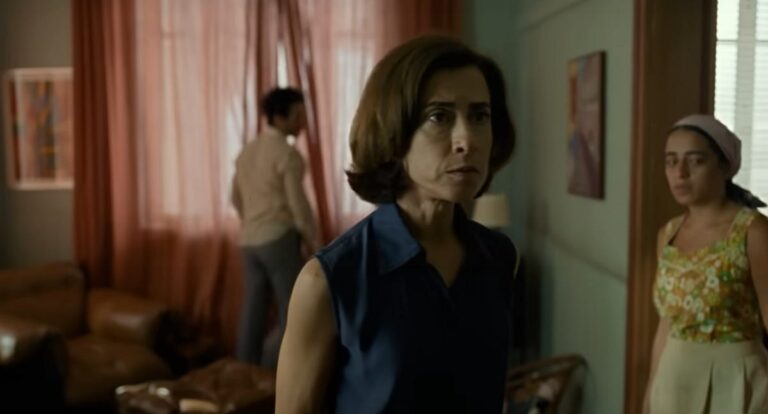
Late in one of the greatest filmic encounters with what scholars have started to conceptualise as the “long 1968,” we listen to a voiceover (VO) calmly narrating the gradual disappearance of one of the film’s protagonists from the visual record. As we watch a short montage of images showing the director’s mother in home videos, his VO informs us that while his “mother appears in a number of home films [and] seems happy, basking in being alive” in footage from the 1960s, this shifts from the 1970s on: images of her “become scarcer, and from ’80 onward, there’s hardly anything at all.” This gradual disappearance of the narrator’s mother from the family’s private filmic record – her becoming-invisible – might register for the attentive viewer as a sign of her death – indeed: of her suicide – not least because this scene appears towards the end of a long sequence of scenes in which death dominates, including the death of both Jan Palach, who burnt himself on 16 January 1969 in protest against the sense of resignation that had befallen Czechoslovakia after the Soviet invasion ended the Prague Spring, and of Killian Fritch, who coined the most famous slogan of May ’68 (“Sous les paves, la plage!” [“Under the paving-stones, the beach!”]) and who committed suicide at Gaité, a Paris subway station meaning “joy.” Yet while the narrator comments on each of these deaths, carefully analysing how the images make use of – instrumentalise – them, he does not mention, let alone discuss, the death of his mother. Instead, he admits that of all the images he has of Elisa Gonçavales, he always returns to those showing her in China in 1966, the moment of Mao’s Cultural Revolution, because these “poor, badly filmed images” provide a record of his mother’s “encounter with the reality of a country that was the opposite of everything she knew. As I remember it,” he says, “nothing made my mother light up like the memory of that time. She spoke of it with delight, with joy, with an intensity that time would come to steal from her. She was happy in China, and that’s why I like to think of her there, back when everything seemed possible.”